Quick answer
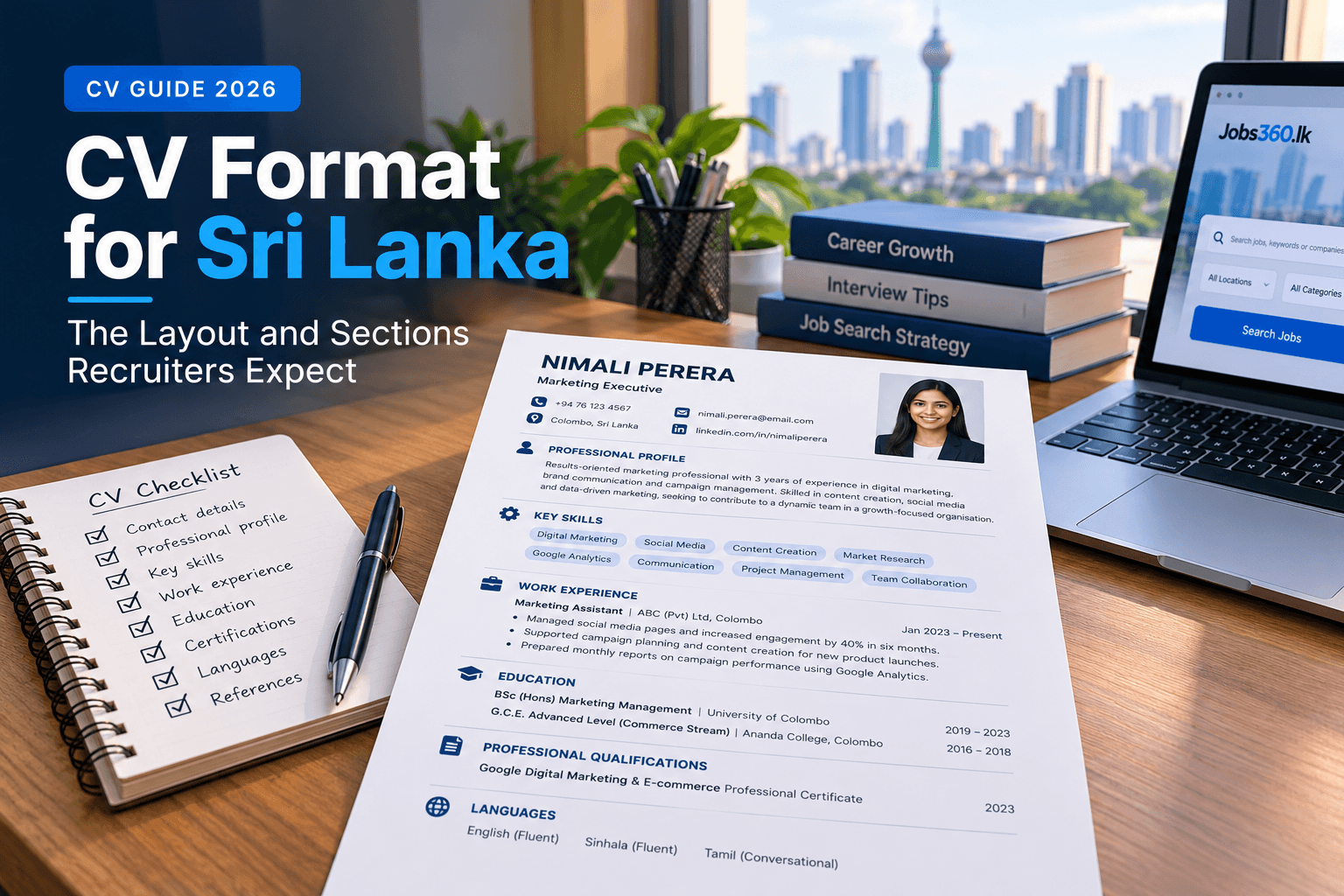
The best CV format for Sri Lanka is a clean, reverse-chronological CV of one to two pages that starts with your contact details and a short professional profile, followed by key skills, work experience with measurable results, education and professional qualifications. Save it as a PDF and tailor it to every job you apply for.
Key takeaways
- Keep your CV to one page if you are a fresher and two pages if you are experienced.
- Use a reverse-chronological layout most recent job and qualification first.
- Lead with a 3–4 line professional profile aimed at the specific job title.
- Show results with numbers instead of listing duties.
- Leave out NIC number, religion, family details and salary history unless asked.
In this article
Is a CV the same as a resume in Sri Lanka?
In Sri Lanka, "CV" and "resume" are used interchangeably. Employers almost always ask for a "CV", but what they expect is a concise, resume-style document of one to two pages not a long academic curriculum vitae.
The exception is academic, research and some government roles, where a longer CV listing publications, research and full qualifications is acceptable.
What is the best CV format for jobs in Sri Lanka?
The reverse-chronological format is the safest choice for almost every job in Sri Lanka. It lists your most recent experience first, which is exactly what recruiters want to see.
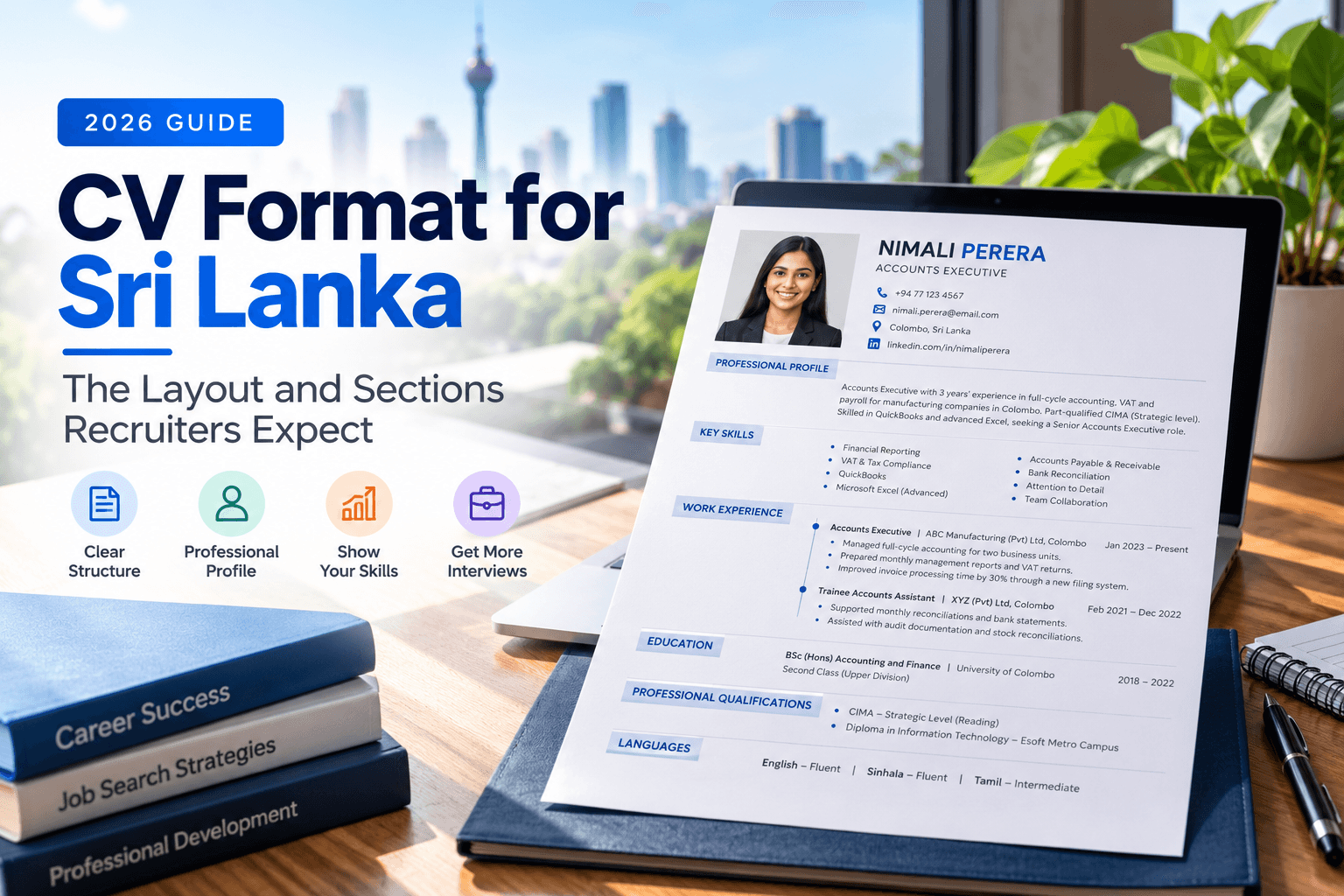
Use this order:
- Contact details — full name, mobile number, professional email, city, and LinkedIn profile.
- Professional profile — three or four lines summarising who you are, your experience and the role you are targeting.
- Key skills — 6–10 skills that match the job advert (technical and soft skills).
- Work experience — job title, company, location, dates, and 3–5 bullet points with results.
- Education — degree or diploma, university or institute, and year. Include A/L and O/L results if you are a fresher.
- Professional qualifications and certifications — CIMA, ACCA, CA Sri Lanka, AAT, CIM, NVQ, AWS, Google certifications and similar.
- Languages — English, Sinhala and Tamil, with your level of proficiency.
- References — two non-related referees, or "Available on request".
What to include in each section of your CV
Professional profile
Write it for the job you want, not the job you had. For example:
"Accounts Executive with 3 years' experience in full-cycle accounting, VAT and payroll for manufacturing companies in Colombo. Part-qualified CIMA (Strategic level). Skilled in QuickBooks and advanced Excel, seeking a Senior Accounts Executive role."
Work experience
Replace duties with achievements. Instead of "Handled customer complaints", write "Resolved an average of 40 customer queries a day and improved the team's satisfaction score from 82% to 91%."
Education and qualifications
List your highest qualification first. Freshers should include their degree class or GPA (if strong), A/L stream and results, and relevant projects or internships.
Skills
Mirror the job advert. If the vacancy asks for "Power BI", "SQL" and "stakeholder management", and you have those skills, use the same words. Many larger employers use applicant tracking systems that match these keywords.
What should you leave out of a Sri Lankan CV?
Older CV templates still circulating in Sri Lanka include personal information that recruiters no longer need. Remove these unless the employer explicitly asks for them:
| Leave out | Why |
|---|---|
| NIC number | Protects you from identity misuse; provide it only after an offer |
| Religion, race and marital status | Not relevant to your ability to do the job |
| Parents' names and occupations | Uses space that should show your skills |
| Full home address | City or district is enough at the application stage |
| A photo (unless requested) | Many employers prefer CVs without photos to reduce bias |
| Salary history | Discuss expectations at the interview instead |
| Hobbies with no relevance | Keep only interests that show skills or leadership |
How long should a CV be, and how should it look?
- Freshers and school leavers: one page.
- 2–10 years' experience: up to two pages.
- Senior and specialist roles: two pages, with older roles summarised briefly.
For design, keep it simple: a clean font such as Calibri, Arial or Inter at 10–12pt, clear headings, consistent dates, and plenty of white space. Avoid heavy colours, graphics, skill-level bars and tables that applicant tracking systems cannot read.
Always save and send your CV as a PDF, named professionally for example, Nimal-Perera-CV-Accounts-Executive.pdf.
How should freshers write a CV with no experience?
If you have little or no work experience, lead with what you do have:
- Education first — degree, diploma, A/L results and relevant modules.
- Projects — final-year projects, group assignments, GitHub repositories or case competitions.
- Internships and part-time work — even short placements show responsibility.
- Volunteering and leadership — societies, sports captaincy, Rotaract, Leo Club or community work.
- Certifications — free online courses in Excel, digital marketing, coding or data analysis add credibility.
See our full guide to jobs for freshers in Sri Lanka for roles that hire graduates without experience.
Common CV mistakes that get applications rejected
- Spelling and grammar errors — run a spell check and ask someone to proofread.
- An unprofessional email address — create a simple firstname.lastname address.
- One generic CV for every job — tailor the profile and skills each time.
- Long paragraphs — use short bullet points that are easy to scan.
- Missing or wrong contact number — double-check it, and make sure your voicemail works.
- Unexplained gaps — briefly mention study, caregiving or freelancing periods.
Once your CV is ready, browse the latest vacancies on Jobs360.lk and start applying.
Frequently asked questions
What is the correct CV format for Sri Lanka?
Use a reverse-chronological CV of one to two pages with contact details, a professional profile, key skills, work experience with results, education, professional qualifications, languages and references.
Should I add a photo to my CV in Sri Lanka?
Only if the job advert asks for one. Many Sri Lankan employers no longer require a photo, and leaving it out keeps the focus on your skills. If you do add one, use a recent, professional headshot.
Should I include my NIC number on my CV?
No. You do not need to include your NIC number on your CV. Provide it only when an employer requests it during the hiring or onboarding process.
Should I send my CV as a Word file or a PDF?
Send a PDF unless the employer asks for Word. A PDF keeps your formatting consistent on every device.
How many references should I include on my CV?
Include two non-related referees ideally a former manager and a lecturer or senior colleague with their designation, organisation, phone number and email. Ask their permission first.

Written by
Jobs360.lk Editorial Team
Jobs360.lk is an AI-powered recruitment platform connecting job seekers and employers across Sri Lanka. Our team shares practical guidance on job searching, CVs, interviews and career growth.
About Jobs360.lkYour CV is ready now find the right job
Explore thousands of AI-matched vacancies from leading Sri Lankan employers.
Find Jobs